When it comes to open-world RPGs, no series is more well-known thanThe Elder Scrollsfranchise. While the games have been especially popular since the release ofThe Elder Scrolls V: Skyrima decade ago, they have been a staple of the RPG genre for far, far longer.
RELATED:Most Iconic Elder Scrolls Armor Sets (& Some That Need More Love)

EarlyElder Scrollsgames likeArena,Daggerfall, andMorrowindwere completely different than themore recentOblivionandSkyrim.Not only were they naturally much more difficult being RPGs from the ’90s and early 2000s, but they also offered gameplay mechanics and tropes that have largely been abandoned by the series in modern iterations.
Updated July 28, 2025 by Erik Petrovich: The Elder Scrolls series has changed greatly over the years. The original games were 2D isometric games, while Morrowind and beyond have all been rendered in 3D, for example, but the differences go a lot deeper than visuals. Arena, Daggerfall, and Morrowind had more niche audiences and could approach more taboo subjects and include more risque dialogue. Oblivion and Skyrim have changed over the years, too, though the major overhauls to these games come by way of their modding communities more than official releases. No two games in the series are the same, but some house features and concepts completely unique to themselves.

Completely Broken Glitches
Earlier games in theElder Scrollsseries, likeArenaandDaggerfall, had very few glitches, in part thanks to the lack of a proper physics engine.OblivionandSkyrimwere rife with glitches, and on release had countless glitches that would crash the game or otherwise prevent progression – game-breaking glitches are expected ofElder Scrollsgames nowadays.
The modding communities behind the modern iterations of the series have, for the most part, fixed these glitches via patches, overhauls, and reworks. Some of this credit goes to Bethesda who rolled out a number of updates to fix these game-breaking issues. While players can expect to encounter glitches galore inElder Scrolls VI, addons have made the released games playable.

Strictly Adult Themes And Dialogue…
Something that is markedly different aboutOblivion,Skyrim, andElder Scrolls Onlineis their relatively family-friendly tone. That isn’t to say that these games don’t deal with mature issues, but compared toArena,Daggerfall, and especiallyMorrowindthey are quite tame.
For instance, inMorrowind,there is a Dremora who says he will take quite a nefarious action against the player’s body after they die (and that’s putting it really, really lightly). InArenaandDaggerfalla number of NPC models featured nudity. WhileOblivion,Skyrim, andESOeach certainly have adult-oriented storylines and dialogue, it’s nothing compared to earlier games in the series.

…And Prolific NPC Nudity
ArenaandDaggerfallwere the first twoElder Scrollsgames released in the ’90s, and for the most part each has aged pretty well considering the hardware and graphical limitations of the time. One way they haven’t aged too well, though, is the vast number of nude NPC and player models.
RELATED:Skyrim: Is SkyrimVR Worth It?
Both male and female characters are seen baring all throughout both games, but women tend to be portrayed more scantily than men. InElder Scrollsgames sinceMorrowindoutright nudity has been replaced with undergarments for characters and NPCs of all races.
Star Signs, Custom Classes, And Similar Customizations
When starting out a new game in every mainlineElder Scrollsgame exceptSkyrim, players are almost immediately given anumber of character-building optionsto customize.MorrowindandOblivion, for example, give the player the choice to make a custom class with a focus on particular attributes, and just about every entry offers Star Signs from the get-go.
InSkyrim, the class and star sign systems were taken away for a more open-ended character progression and the introduction of Standing Stones. Many players miss these classic RPG character systems from the otherElder Scrollsgames, though, and are hopingThe Elder Scrolls VIwill bring back some of these mechanics that the series was once known for.
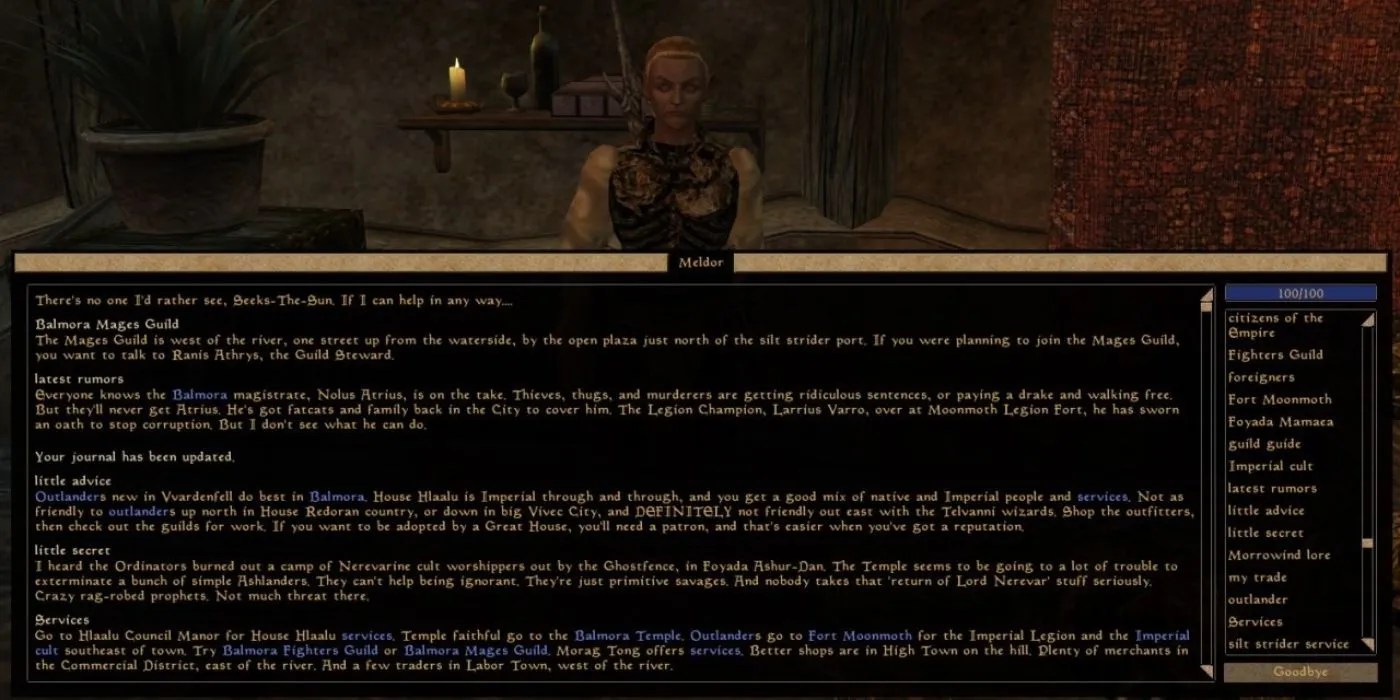
No Quest Markers Means NPC Dialogue Is More Important…
WhileOblivionandSkyrim(andThe Elder Scrolls Online) practically guide the player to their next objective with NPC, map, and quest markers,earlierElder Scrollsgamesdid no such thing. InMorrowind, which has an accessible overworld map, players have to pay attention to their surroundings and follow directions to get to their quest locations.
Some modern games likeRed Dead Redemption 2have made decent attempts to bring this type of gameplay back as it helps to immerse players in the world that is being presented. On the other hand, it’s a lot more to keep track of, and it’s easy to get lost when directions aren’t as clear as they could be.

…And The Journal Catalogues Text Chronologically, Not By Quest
One of the common tropes of the earlyElder Scrollsgames was how simultaneously confusing and detailed the player’s journal can be. InMorrowindquests are writteninto the player’s journal as they happen, and can’t be sorted by quests like inOblivionand later games, meaning it’s very common for players to remember page numbers for important details.
RELATED:Skyrim: Mods That Leave High Expectations For The Elder Scrolls 6

Mechanics like this tend to divide players. On one hand, it’s incredible for immersion to have detailed directions, quest objectives, and names all cataloged in the order they were received. On the other hand, quests can be easily lost if not being actively tracked, and it can be easier to get quests completed when they are sortable.
Starting Out Exclusively As A Prisoner
The most common trope throughout theElder Scrollsgames is that the playeralwaysstarts out as a prisoner of some description. InArenathe player is imprisoned by Jagar Tharn, inDaggerfallthe player starts in a dungeon, inMorrowindit’s a prison ship, and the player inOblivionis freed by the Emperor – and then there’salsoSkyrim’s famous opening.
However,The Elder Scrolls Onlineoffers a multitude of different starts (including a prisoner in Coldharbor), and mods allow for canonical alternative starts. This means that the most recent twoElder Scrollsgames have not forced the player to start in a prison, though it’s likelyThe Elder Scrolls VIwill continue the trend.

The Games Were Extremely Hard Before Oblivion
BeforeOblivionwas released, theElder Scrollsfranchise was known for its incredible difficulty. This is partly the fault of now-dated systems like the quest journal and a lack of a map, but it’s also because the games didn’t hold back in challenging players.
RELATED:Mistakes Everyone Makes On Their First Playthrough Of The Elder Scrolls IV: Oblivion

The introductory segment for every game up toOblivioncan be completed in about 5 minutes.Morrowind’s tutorial consists of a single bureaucratic building, whileOblivion’s sets up the main story, introduces every combat mechanic, takes the player through a basic dungeon, and then sets them out on their adventure only when the developers are ready to let go of the player’s hand.
UntilSkyrim, focusing on Magicka-based abilities was a near-guaranteed way to make the game easier. While Magicka builds are harder to get into at first, they alwaysended up being overpoweredcompared to melee or ranged builds thanks to the variety of high-tier spells and features like spellcrafting.

While being a Mage is totally possible inSkyrim, it’s not nearly as overpowered as it was even inOblivion. Spellcrafting as a mechanic is sorely missing fromSkyrim, though it was probably removed to keep Mage builds balanced with the rest of the game.
Questionable (But Hilarious) NPC Interactions
BeforeSkyrimandThe Elder Scrolls OnlineNPCs andvoice acting throughout theElder Scrollsserieswere diverse, to say the least. Characters like Jiub fromMorrowindor the guards fromOblivionare vocal standouts to be certain, but there are a number of NPCs (likeOblivion’s Dunmer) who got the shaft when it comes to VA. For the most part,Skyrimhas great VA throughout.
Additionally, almost everyElder Scrollsgame has AI systems in place to create a living world around the player, including NPC routines and interactions. Sometimes, though, these systems break, leading to hilarious encounters like a man telling everyone he meets that he doesn’t care for them inOblivion, or a thief saying the money he just stole “means nothing to me”.
MORE:The Complete Guide to Skyrim - Items, Quests, Mods, Builds, and Tips
