Summary
In the vast majority of cases,anime is a medium that intends to entertain, narrating stories tinged with a distinctive aesthetic while adhering to certain tropes that have become associated with its many offerings. However, every once in a while, a franchise emerges from among the crowd to challenge norms in the usual fare of seasonal anime, raising pertinent questions on a variety of topics.
These can range from poignant examinations of the human condition and its associated struggles to more broad debates on civilization, war, morality, environmentalism, and other issues.Some of these titles have gone on to attaincult or iconic status in the realm of anime and fiction as a whole, exerting an incredible degree of influence on popular culture.

Following the travels of Ginko, a healer who can perceive the primitive life forms known as “mushi,“Mushishicombineselements of the supernatural with a predominantlyslice-of-life setting.
Filled with subtle anachronisms that conceal the time period the series takes place in,Mushishiexudes a timelessness in its examination of everyday life, as well as the intricacies of mental health and the long-lasting effects of trauma. The series is known for the calming quality of its visual style, as well as the underlying moral themes it depicts.

Equalparts psychological thriller and cyberpunk fantasy,Ergo Proxyis heavily influenced by Gnosticism and other schools of philosophy, including the works of René Descartes. In a distant future where ecological disasters have made the planet virtually uninhabitable, the story ofErgo Proxybegins in Romdeau City, one of many domed cities where humans and androids can safely coexist.
Following Re-L Mayer, the daughter of the city’s regent, the series traces her investigation into the Cogito virus and the mysterious beings known as Proxies, who appear to be connected to Vincent Law, a figure who unexpectedly enters her life.

Undoubtedly one of anime’s most well-known global exports, Hideaki Anno’sNeon Genesis Evangelionis as acclaimed as it is controversial. While itmay initially present itself as a mecha franchisefeaturing a large amount of religious symbolism, the real heart ofEvangelionis its characters, who struggle with their inner demons as they simultaneously confront the world-ending threat of the Angels.
The series examines issues of social anxiety, childhood trauma, libido-destrudo conflicts, and Freudian concepts regarding familial and interpersonal relationships.

Naoki Urasawa’s reimagining of Osamu Tezuka’sAstro Boyfollows Europol agent Inspector Gesicht, as he investigates a gruesome series of murders involving powerful robots and robot sympathizers across the world.
From new interpretations of Isaac Asimov’s “Three Laws of Robotics,” to examinations of how to create artificial intelligence that emulates every facet of human consciousness,Plutois an incredible Netflix anime adaptationof an already highly acclaimed manga that elevates its source material in every way imaginable, without losing any nuance in its true meaning.

Combining episodic storylines in the style of an anthology series, with longer plot threads that play out over the course of its 26-episode run,Cowboy Bebopis aspace-western set in the near future, following a crew of rag-tag bounty hunters.
Its depiction of a space-faring civilization and the impact of advanced technology on everyday life has received much praise, with the show’s mechanical design standing out in particular. However, its true triumph comes from its exploration of themes such as identity, existential ennui, isolation, and the struggle to escape one’s past.

Centered on the journey of its titular protagonist,Violet Evergardenfollows the struggles of a former soldier to reintegrate into society after knowing nothing but war for her entire life.
Covering topics such as post-traumatic stress disorder and the difficulties of forging a new identity, theseries tackles complex subjects with an impressive degreeof nuance, aided by a very aesthetically appealing visual style that puts many of its peers to shame.

A shy young high school student Lain Iwakura finds herself cast into the complex virtual world of “The Wired” after receiving a text message from a recently deceased classmate. What ensues is a series of surreal incidents where Lain shatters the barrierbetween the physical and digital worldswhile losing her sense of identity in the process.
Revolutionary for its time,Serial Experiments Lainis especially relevant today, when the majority of human communication takes place in the virtual sphere, producing a society where individuals are prone to experiencing paranoia, loneliness, and alienation.

Much like Satoshi Kon’s other works,Perfect Blueis a psychological thriller that blurs the line between fantasy and reality while delving into the destabilizing psyche of a Japanese idol who navigates the pitfalls of fame.
Under immense stress from dealing with her declining public image, as well as a frightening series of encounters with a disturbing stalker, the film’s protagonist Mima Kirigoe, begins to lose her grip on reality.Perfect Blueis an all-too-real depiction of the dark side of stardom and has inspired many imitators in the years since its release.

Psycho-Passtakes place in 22nd-century Japan, where crime is thwarted with the aid of an artificial intelligence known as the “Sibyl System,” which evaluates an individual’s potential for criminal activity via a brain scan.
The series follows rookie Inspector Akane Tsunemori and her relationship with the Enforcer Shinya Kogami, as the pairnavigate the complexities of morality in an agewhere latent criminality can be determined by technology, with AI serving as judge, jury, and executioner all at once.
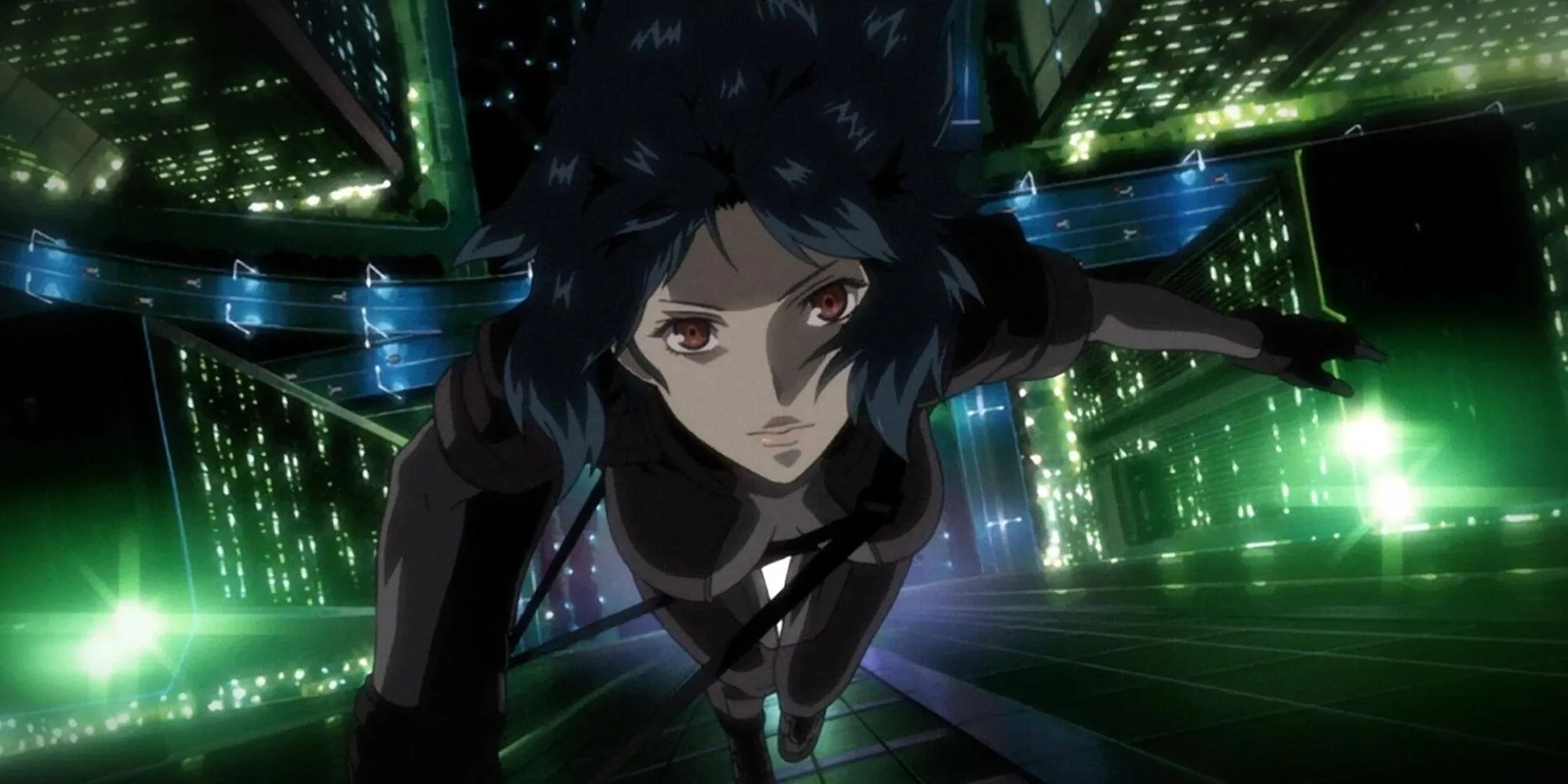
Although it features several deviations from Masamune Shirow’s original manga series, Mamoru Oshii’sGhost in the Shellisan era-defining work in the cyberpunk genre. While its animation was far ahead of many of its peers at the time, the film’s narrative and character writing is perhaps where it shines best.
Posing intriguing questions on memory, consciousness, and identity in a world where bodily cybernetic enhancement is a common occurrence, the film, and its associated media franchise, have garnered almost universal acclaim for tackling ideas about artificial intelligence, post-gendered characters, and the human desire for self-preservation.
